
¿Para qué se usa una linterna ultravioleta de 395 nm?
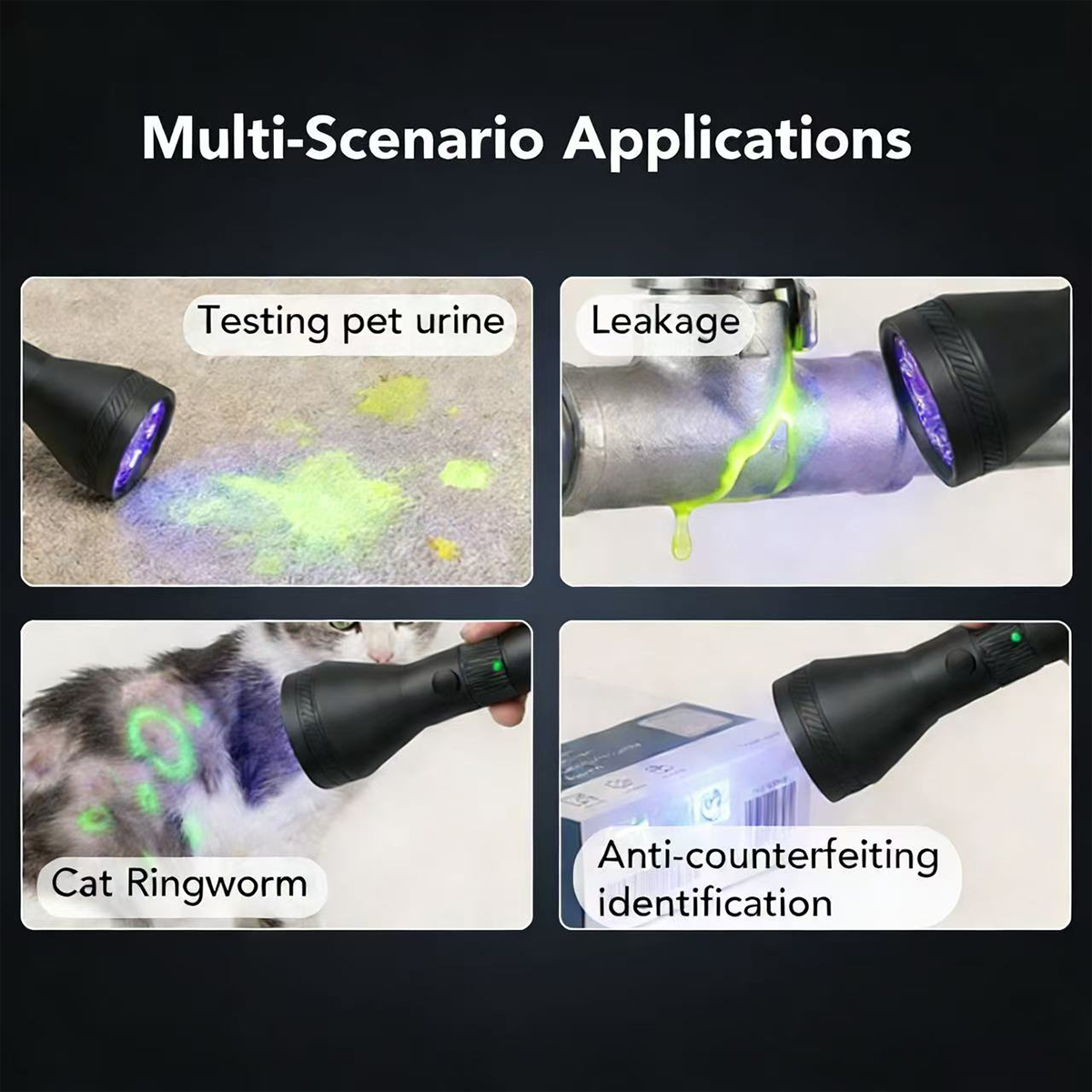
Una linterna ultravioleta de 395 nm es una luz de inspección ultravioleta portátil utilizada para hacer que ciertos materiales fluorescentes, tintes, tintes, etiquetas o recubrimientos sean más visibles bajo una iluminación cercana a los rayos UV. En comparación con las opciones UV de menor visibilidad, 395nm suele producir un resplandor púrpura más perceptible, lo cual puede ser útil para inspecciones de gran área, controles ambientales de mascotas, revisión antifalsificación, asistencia en inspección de fugas y soporte para el curado UV. La detección real depende de si el material objetivo reacciona con la fluorescencia, por lo que no debe considerarse una prueba universal. L13 es un ejemplo profesional de luz UV para herramientas. Los compradores B2B deben evaluar la aplicación, la longitud de onda, la cobertura, el sistema eléctrico y la estructura de viviendas antes de seleccionar o desarrollar unaLinterna UV de 395nm.
Por qué la detección UV profesional necesita más que luz morada visible
Muchas luces UV de nivel básico impresionan en las fotos de los productos porque el resplandor morado visible es muy intenso. Para los compradores profesionales, eso no es suficiente. Una luz UV portátil de inspección debe evaluarse por rango de longitud de onda, disposición del LED, cobertura, estabilidad energética, comportamiento óptico, fiabilidad de la carcasa y lenguaje de aplicación seguro.
La luz púrpura visible no es lo mismo que la eficiencia de excitación por fluorescencia. Las trazas de mascotas, tintas para etiquetas, tintes refrigerantes, tintes lubricantes, materiales curados por UV y características antifalsificación pueden responder de forma diferente a las longitudes de onda y a las condiciones de inspección. Un producto que parece brillante a simple vista puede no crear siempre el contraste necesario para la tarea específica.
La inspección de campo también requiere una iluminación estable. Los técnicos de mantenimiento, distribuidores, marcas de suministros para mascotas y marcas de herramientas necesitan un producto que pueda transportarse, alimentarse, manipularse y explicarse adecuadamente. Los compradores B2B deberían evitar juzgar una linterna UV solo por una imagen de haz morado o por una simple afirmación de brillo.
¿Qué hace diferente a una linterna ultravioleta de 395nm?
Una linterna ultravioleta de 395nm funciona en el rango ultravioleta cercano y suele producir más luz púrpura visible que muchos productos UV de 365nm. Ese resplandor visible puede ayudar a los usuarios a ver hacia dónde se dirige el haz, lo que puede ser útil en inspecciones de gran área, mantenimiento cotidiano y líneas de productos aptas para distribuidores.
En comparación con 365nm, 395nm puede ser una opción práctica cuando el coste, la cobertura, la disponibilidad y el uso general en campo importan. A menudo se utiliza para inspección del entorno de mascotas, revisión antifalsificación, inspección de etiquetas y documentos, asistencia para el curado UV e inspección de fugas de refrigerante cuando hay tinte fluorescente compatible.
Sin embargo, la selección de longitudes de onda nunca debe simplificarse en una respuesta absoluta. Para aplicaciones que requieren menor interferencia de luz visible y mayor contraste de fluorescencia, 365nm puede ser más adecuado. Para aplicaciones donde la guía de haz visible, una mayor cobertura y un posicionamiento práctico en el mercado son importantes, el 395nm puede ser una opción sólida. El sourcing profesional debe comenzar con la aplicación objetivo.
Estudio de caso L13: Una luz UV de herramientas de 12 LED y 395 nm
L13 es unLuz de herramientasproducto posicionado como una linterna de inspección UV de 395–400 nm para aplicaciones profesionales y civiles. No es un dispositivo diagnóstico médico, ni una luz de buceo, ni una linterna de arma táctica ni una linterna genérica de luz blanca. Su valor proviene de combinar una matriz UV multiLED, diseño de doble potencia, carcasa de aluminio y una estructura práctica orientada al campo.
La estructura de soplete UV de 12 LEDs soporta una cobertura más amplia que una fuente UV de punto único muy pequeña. Para comprobaciones del entorno de mascotas, revisión de documentos, inspección de tintes fluorescentes y kits de herramientas de mantenimiento, una iluminación más amplia puede ayudar a los usuarios a escanear las superficies de forma más eficiente.
La longitud de onda de 395–400nm hace que L13 sea adecuado para muchos escenarios de inspección de fluorescencia visible y asistencia industrial. La opción de batería de litio 18650 soporta un uso profesional repetido, mientras que la configuración de tres pilas alcalinas AAA proporciona comodidad de reemplazo local para trabajos de campo y mercados de distribución.
El cuerpo de aleación de aluminio 6063 y el acabado anodizado negro ayudan a posicionar a L13 como una linterna UV de aluminio para uso en herramientas, en lugar de una luz de plástico desechable para novedad. IPX4 soporta salpicaduras ligeras y ambientes de trabajo generales, pero no debe describirse como una calificación de buceo. La resistencia al impacto de 1 metro es adecuada para el uso normal de herramientas, no para el uso industrial pesado. El tamaño es de φ49,5 mm para la cabeza de la lámpara × 194,6 mm de longitud total.
¿Dónde tiene sentido la luz UV de herramientas L13?
L13 es especialmente relevante cuando el usuario necesita una luz de inspección UV portátil con mayor cobertura, opciones de potencia aptas para el campo y un cuerpo tipo herramienta más resistente. Debería estar orientado a la asistencia de inspección de fluorescencia, no a afirmaciones universales de detección.
Linternas UV de 365nm vs 395nm: lógica de selección para compradores B2B
Tanto las linternas UV de 365nm como de 395nm pueden ser útiles si se ajustan a la aplicación correcta. ALinterna UV de 395nma menudo es práctico para una inspección visible más amplia y líneas de productos sensibles al coste, mientras que puede preferirse 365nm para menor interferencia de luz visible y mayor contraste en algunos materiales fluorescentes.
| Factor de selección | UV de 365nm | UV de 395nm | Conclusión del comprador |
|---|---|---|---|
| Luz púrpura visible | Normalmente hay menos luz morada visible. | Normalmente hay una luz morada más visible. | 395nm puede ser más fácil para los usuarios apuntar visualmente. |
| Contraste de fluorescencia | Puede proporcionar un contraste más alto para algunos materiales. | Puede funcionar bien para muchas aplicaciones de fluorescencia visible. | Prueba con el material objetivo real antes de decidir. |
| Nivel de coste | A menudo más alto dependiendo de los requisitos del LED y del filtro. | A menudo es más accesible en costes para líneas de productos amplias. | El coste debe equilibrarse con los objetivos de inspección. |
| Inspección de amplia área | Útil cuando se diseña con ópticas y salida adecuadas. | Práctico para una inspección visual más amplia con distribuciones multi-LED. | La cantidad de LED y la cobertura del haz importan tanto como la longitud de onda. |
| Inspección de manchas para mascotas | Puede proporcionar un contraste más fuerte para ciertos rastros. | Comúnmente utilizado para asistencia en la inspección visible de áreas de mascotas. | Ninguna luz ultravioleta garantiza que todas las manchas aparezcan. |
| Antifalsificación | Útil para algunas funciones de seguridad. | Útil para muchas comprobaciones de tinta UV visible o etiquetas. | La detección depende del material y del sistema de marcado. |
| Detección de fugas con tinte fluorescente | Puede ser adecuado cuando el tinte responde bien. | Puede ser adecuado para tintes fluorescentes compatibles. | El sistema de tintes debe coincidir con la fuente UV. |
| Asistencia para el curado UV | Puede adaptarse a materiales especificados para este rango. | A menudo es práctico para materiales reactivos a rayos UV adecuados de 395–400 nm. | Confirma los requisitos del material de curado antes de conseguir. |
| Posicionamiento ideal del producto | Inspección profesional de mayor contraste en usos seleccionados. | Herramientas UV profesionales, para mascotas, mantenimiento y distribuidores amplias. | Coloca el producto en torno al ajuste de la aplicación, no al prestigio de la longitud de onda. |
Por qué importa Dual Power en las herramientas de inspección UV
Las herramientas de inspección UV se utilizan a menudo en el campo, en vehículos de servicio, alrededor de salas de equipos, dentro de viviendas o en entornos de inspección minorista. Una herramienta puede permanecer sin usarse durante un tiempo y luego ser necesaria inmediatamente. Esto hace que la planificación energética sea importante tanto para los usuarios finales como para los distribuidores.
L13 soporta una batería de litio 18650, 3,7V, 1200mAh, o tres pilas alcalinas AAA con soporte para batería. El formato 18650 es adecuado para el uso repetido y la planificación de productos recargables. La ruta de respaldo AAA proporciona comodidad de reemplazo local cuando un usuario necesita baterías durante viajes, trabajos de servicio o uso en tiendas.
Para los compradores B2B, el dual power no debe tratarse como una simple etiqueta. La estructura debe tener en cuenta el diseño del compartimento de la batería, la estabilidad del contacto, la compatibilidad del circuito del controlador, las instrucciones de usuario y el funcionamiento seguro. Una linterna ultravioleta de doble potencia debería facilitar el uso en campo, no crear confusión.
¿Qué deberían comprobar los compradores B2B antes de adquirir linternas UV?
La obtención profesional de linternas UV debe comenzar con las afirmaciones de ajuste y seguridad de la aplicación. Los compradores B2B deben evitar afirmaciones exageradas como diagnóstico médico, detección garantizada de manchas o detección universal de falsificaciones. Las siguientes ocho preguntas ayudan a organizar una discusión sobre la fábrica de linternas UV antes de la producción.
¿Qué longitud de onda UV se adapta a la aplicación?
Empieza por el objetivo de la inspección. Las trazas para mascotas, tintes, etiquetas, recubrimientos y materiales de curado pueden responder de forma diferente. Una linterna ultravioleta de 395nm puede ser práctica, pero puede preferirse 365nm para algunos requisitos de mayor contraste.
¿Cuánta cobertura proporciona la matriz LED?
La cobertura afecta a la velocidad de inspección. Un diseño de soplete UV de 12 LED puede soportar una comprobación de área más amplia que una fuente puntual muy pequeña. Los compradores deben evaluar la uniformidad de la viga y la distancia práctica de trabajo.
¿El producto necesita 18650, AAA o doble alimentación?
La energía de litio recargable permite el uso repetido, mientras que las pilas AAA son fáciles de encontrar localmente. La doble alimentación puede mejorar la flexibilidad del distribuidor, pero la estructura y las instrucciones deben ser claras.
¿Es la carcasa adecuada para uso con herramientas?
Las luces de herramientas se manipulan, almacenan y trasladan con frecuencia. La carcasa de aluminio, el acabado superficial, el agarre y la estructura de la cabeza de la lámpara ayudan a definir si el producto se siente como una herramienta profesional de inspección.
¿Qué nivel de impermeabilidad y impacto es realista?
Los niveles de protección deben coincidir con el entorno real. La resistencia al impacto IPX4 y de 1 metro pueden adaptarse al uso general de herramientas, pero no deben presentarse como protección para buceo o para la industria pesada.
¿Son seguras y cumplen las reclamaciones para el mercado objetivo?
Las reclamaciones deben evitar el diagnóstico médico, la detección bacteriana, la detección garantizada de manchas o la identificación universal de falsificaciones. El lenguaje seguro protege a la marca y apoya expectativas más claras de los clientes.
¿Puede el embalaje explicar la seguridad UV y los límites de aplicación?
El embalaje debe ayudar a los usuarios a comprender la longitud de onda, las opciones de batería, los escenarios de aplicación, las advertencias de seguridad ocular y los límites de detección. Instrucciones claras reducen el mal uso y la confusión postventa.
¿Puede el fabricante soportar cambios OEM/ODM antes de la producción?
Un fabricante profesional de linternas UV debe soportar los cambios en la longitud de onda, cantidad de LED, carcasa, estructura de la batería, embalaje y lenguaje de advertencia antes de que se bloqueen las decisiones de producción.
Cómo SHENGQI LIGHTING soporta proyectos de herramientas UV de luz OEM/ODM
ILUMINACIÓN SHENGQIes la marca de Dongguan Shengqi Lighting Technology Co., Ltd., con raíces manufactureras que se remontan a 1981. Dongguan Shengqi Lighting Technology Co., Ltd. se estableció formalmente en 2008. La empresa se centra en linternas, productos de iluminación portátil y servicios de fabricación OEM/ODM.
La empresaCartera de productosincluye linternas EDC, lápices de bolígrafo, linternas exteriores, linternas tácticas, faros, luces de acampada, luces de caza, luces de buceo,Luces de herramientas, accesorios y productos OEM. Para proyectos de iluminación UV como L13, el valor práctico no es solo producir una linterna UV. El valor está en ayudar a las marcas B2B a definir la longitud de onda adecuada, la disposición de los LEDs, el sistema eléctrico, la estructura de la carcasa, las instrucciones de embalaje, el lenguaje de seguridad y el posicionamiento en el mercado.
La empresa apoyaServicios OEM/ODMincluyendo Diseño Industrial, Diseño de Ingeniería Óptica, Diseño Electrónico, Diseño de Envases, Fabricación y Ensayos. Sus capacidades en fábrica incluyen unos 130.000 pies cuadrados de espacio de fabricación, 75 máquinas CNC, una línea de producción SMT totalmente automatizada, dos líneas de soldadura y once líneas de montaje libres de polvo.
Para un proyecto de linterna UV de aluminio o linterna UV personalizada, los recursos CNC apoyan la producción de vivienda y la consistencia dimensional. La línea SMT automatizada soporta ensamblaje electrónico. Las líneas de soldadura y las líneas de montaje libres de polvo apoyan el control de producción. Los recursos de prueba ayudan a evaluar la vida útil del interruptor, vibraciones, caídas, rendimiento luminoso, temperatura, comportamiento en altas y bajas temperaturas, rendimiento en resistencia al agua y comportamiento de la batería. ElAntecedentes de la empresaestá apoyado por un sistema de gestión de calidad ISO9001 para la gestión organizada de la fabricación.
Preguntas frecuentes
1. ¿Qué es una linterna ultravioleta de 395nm?
Una linterna UV de 395 nm es una luz portátil de inspección cercana al ultravioleta que puede ayudar a hacer que ciertos materiales fluorescentes, manchas, tintes, etiquetas, recubrimientos o marcas sean más visibles. Normalmente produce un resplandor púrpura perceptible porque 395 nm está cerca del rango de luz visible. Esto lo hace práctico para inspecciones de amplia área, controles ambientales de mascotas, revisiones antifalsificación, kits de herramientas de mantenimiento e inspección de fugas asistidas por colorante fluorescente. Debe usarse como ayuda de inspección, no como herramienta universal de detección.
2. ¿Es mejor 395nm o 365nm para inspección UV?
Ninguna de las dos longitudes de onda es automáticamente mejor para cada tarea de inspección. Una luz ultravioleta de 365 nm puede proporcionar un contraste más fuerte para ciertos materiales fluorescentes con menos luz púrpura visible. Una linterna UV de 395 nm suele ofrecer una guía de haz más visible y puede ser práctica para inspecciones de amplia área, revisiones de manchas de mascotas, revisión de etiquetas, inspección asistida de tintes y productos de distribuidores sensibles al coste. Los compradores B2B deberían probar el material objetivo real, el entorno de iluminación y las expectativas del usuario antes de elegir la longitud de onda.
3. ¿Qué puede detectar una linterna ultravioleta de 395nm?
Una linterna UV de 395nm puede ayudar a los usuarios a localizar trazas fluorescentes, tintas, tintes, etiquetas, recubrimientos o marcas adecuadas cuando esos materiales reaccionan bajo una iluminación cercana a la UV. Las aplicaciones típicas pueden incluir asistencia en inspección de orina de mascotas, revisión de documentos y etiquetas, comprobaciones antifalsificación, inspección de fugas de lubricante, inspección de fugas de refrigerante con tinte fluorescente compatible y asistencia para curado UV para materiales adecuados. No puede detectar cada mancha, cada marca falsa ni cada fuga por sí sola. El material objetivo debe ser sensible a los rayos UV.
4. ¿Pueden las linternas UV detectar orina de mascota?
Las linternas UV pueden ayudar a revelar ciertos rastros de orina de mascotas porque algunos residuos pueden fluorescer bajo la iluminación ultravioleta. Sin embargo, los resultados dependen de la superficie, la antigüedad de la mancha, los productos de limpieza, la luz ambiental y si el residuo sigue reaccionando de forma visible. Una luz UV no puede garantizar que todas las manchas de las mascotas se vean. Para las marcas de suministros para mascotas, el lenguaje seguro del embalaje debe describir el producto como una ayuda visual para la limpieza en lugar de un detector de manchas garantizado.
5. ¿Puede la linterna UV L13 diagnosticar la tiña de gato?
No. L13 no es un dispositivo diagnóstico veterinario y no debería comercializarse como una herramienta para diagnosticar la tiña en gatos. La luz UV puede ayudar en el cribado visual en algunas situaciones porque ciertas características fúngicas pueden fluorescer, pero no todos los casos se comportan igual y son posibles impresiones falsas. Cualquier diagnóstico final debe basarse en una evaluación veterinaria cualificada. El embalaje y el marketing del producto deben usar una redacción cautelosa, como asistencia visual para el cribado, no confirmación médica.
6. ¿Por qué importa la doble potencia en una luz de herramientas UV?
La doble potencia importa porque las herramientas de inspección pueden utilizarse en condiciones de campo donde la disponibilidad inmediata de energía es importante. L13 soporta una batería de litio 18650, 3,7V, 1200mAh, o tres pilas alcalinas AAA con soporte. La opción 18650 permite la planificación recargable, mientras que las pilas AAA son fáciles de comprar localmente. Para los distribuidores, la doble potencia puede mejorar la flexibilidad del mercado. La estructura, el diseño del contacto y las instrucciones deben ser claros para evitar confusiones del usuario.
7. ¿Cómo pueden las marcas desarrollar una linterna UV personalizada con SHENGQI LIGHTING?
Las marcas pueden comenzar definiendo la aplicación objetivo, la longitud de onda, la cantidad de LED, el área de cobertura, el sistema de baterías, el material de la carcasa, las instrucciones de embalaje, el lenguaje de seguridad y el posicionamiento en el mercado. SHENGQI LIGHTING apoya proyectos de herramientas UV OEM/ODM a través de Diseño Industrial, Diseño de Ingeniería Óptica, Diseño Electrónico, Diseño de Envases, Fabricación y Pruebas. Los responsables de producto y los equipos de aprovisionamiento pueden utilizar elPágina de contactopara discutir un proyecto personalizado de linterna UV y su alcance de producción requerido.
Elige herramientas UV por aplicación, no solo por el brillo morado
ALinterna UV de 395nmpuede ser útil para inspección profesional, soporte para la limpieza ambiental de mascotas, inspección de fugas asistidas por colorantes, revisión antifalsificación, inspección de documentos, asistencia en curado UV y líneas de productos UV de distribuidores. El producto debe evaluarse por longitud de onda, cantidad de LED, cobertura, sistema eléctrico, estructura de la carcasa y límites de aplicación.
L13 demuestra esta lógica con 12 perlas LED UV, salida de 395–400 nm, doble soporte de alimentación, construcción de aleación de aluminio 6063, acabado anodizado negro, grado impermeable IPX4 y resistencia al impacto de 1 metro. Estos hechos la sitúan como una caja profesional para luces UV, no como un dispositivo médico, una luz de buceo o un detector universal.
Las marcas B2B que desarrollan herramientas UV deben evitar afirmaciones exageradas de detección y centrarse en una planificación verídica de la aplicación, redacción de seguridad, claridad del envase y coherencia en la fabricación. SHENGQI LIGHTING puede apoyar el desarrollo, fabricación y pruebas de luces OEM/ODM para marcas, distribuidores y equipos de producto.
Desarrollar proyectos de linternas UV en función de necesidades reales de inspección
Marcas de herramientas, marcas de suministros para mascotas, distribuidores de herramientas de inspección, marcas de productos de servicios HVAC, proveedores de herramientas de mantenimiento, importadores, gestores de producto y equipos de aprovisionamiento OEM/ODM pueden debatir proyectos de linternas UV, selección de longitudes de onda de 395nm o 365nm, diseño de matrices LED, planificación del sistema de baterías, diseño de carcasas de aluminio, envasado y lenguaje de advertencia, fabricación/ODM/ODM, pruebas y soporte de producción con SHENGQI LIGHTING.
Para la comunicación del proyecto, también puedes contactar con el equipo por correo electrónico ensales@shengqilight.com.